- Home
- Company
- Products
- Certification
- work with us
- Contact

This type of filter allows the water to be purified to be treated first with a sand filter for the removal of mechanically filterable solid substances, then with an activated carbon filter, arranged in series, for the reduction of biodegradable solid substances removed by adsorption . These filters are used for refining the quality of the final effluent after chemical-biological treatments of waste water or as completion of the clarification process of surface water treatment for drinking or industrial uses.
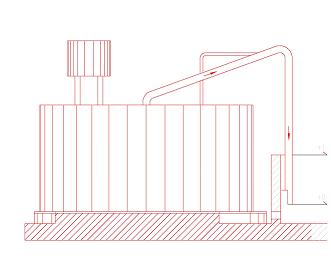
Closed cylindrical container, made of steel, divided into three main sections: a sand filtration chamber (C), a collection chamber for the effluent filtered by the sand (D) and a backwash water storage chamber (I) which the filter bed is needed.
The first filtration zone (C) contains fine monocrystalline sand and a series of plastic diffusers on the bottom which ensure uniform drainage of the filtered water as well as uniform distribution of the backwash water.
The sand-filtered effluent collection area (D) is directly connected to the backwash water tank (I) via a vertical pipe (E).
The backwash water storage area (I) is sized to hold an adequate amount of water and always fills to the same height thus ensuring uniform backwashing
Sand filter composed of a cylindrical steel tank divided into three sections:
a backwash water storage chamber, a filtration chamber and an effluent collection chamber.
The backwash water storage chamber is sized to hold an adequate amount of water and always fills to the same height thus ensuring uniform backwashing. The water to be filtered is introduced from the supply tower through a distributor pipe into the filtration chamber. From this, percolating through the filtration area composed of quartz sand, it reaches the collection chamber via lamellar plastic diffusers, where, through a pipe, it exits the filter and is sent for use. The filtrate collection area is directly connected to the backwash water tank via an open duct in the upper part. The deposit of insoluble substances on the filter bed causes an increase in the pressure drop through it and consequently the water level slowly rises in the supply and backwash pipes. Immediately before the water passes the top bend of the backwash pipe, an automatic drain system sucks the air out of the pipe. Thus, a strong suction occurs which conveys a high flow rate of water into the pipe, creating a siphon which activates the backwashing of the filter. Approximately five times the volume of water passes through the backwash pipe than through the supply pipe. As a result the pressure on the filter bed drops immediately and the water flows from the storage compartment through the connecting pipes, into the filtrate collection chamber from which it moves upwards through the lamellar diffusers, the sand bed and the backwash drain. In this way the filter bed is expanded and perfectly cleaned of the deposited solids. This operation stops when the water level in the storage compartment drops to a level that defuses the siphon.
The water to be filtered flows again by gravity through the filter bed, automatically restoring filtration. The first portion of filtered water rises into the storage compartment and fills it up to the height of the drain from where it begins to be used again.