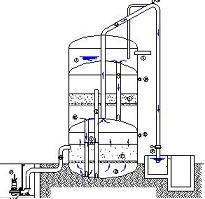
This type of filter allows the water to be purified to be treated first with a sand filter for the removal of mechanically filterable solid substances, then with an activated carbon filter, arranged in series, for the reduction of biodegradable solid substances removed by absorption . These filters are used for refining the quality of the final effluent after chemical-biological treatments of waste water or as completion of the clarification process of surface water treatment for drinking or industrial uses.
Closed cylindrical container, made of steel, divided into five main sections: a first sand filtration chamber (C), a collection chamber for the effluent filtered by the sand (D), a second filtration chamber with activated carbon (F), a collection chamber for the effluent filtered with carbon (G) and a storage chamber for the backwash water (I) which serves both filter beds.
The first filtration zone (C) contains fine monocrystalline sand and a series of plastic diffusers on the bottom which ensure uniform drainage of the filtered water as well as uniform distribution of the backwash water.
The collection area of the effluent filtered with sand (D) is directly connected to the backwash water tank (I) via several vertical ducts (E and H).
The second filtration zone (F) contains activated carbon and a series of plastic diffusers on the bottom which ensure uniform drainage of the filtered water as well as uniform distribution of the backwash water.
The carbon filtered effluent collection area (G) is directly connected to the backwash water tank (I) via multiple vertical ducts (H).
The backwash water storage area (I) is sized to hold an adequate amount of water and always fills to the same height thus ensuring uniform backwashing.
The water to be treated is sent through a feed pump (A) and a pipe (B) directly onto the filter sand bed (C). From here, under the action of gravity, it passes through the sand, losing the impurities it contains. At the bottom of the filtering sand bed, special nozzles and a pipe open in the upper part (E) convey the filtered water directly onto the activated carbon bed (F). The water to be treated, under the action of gravity, passes through the activated carbon and is purified by absorption of the dissolved impurities. At the bottom of the activated carbon bed, special nozzles and a pipe open in the upper part (H) convey the water directly towards the backwash water storage chamber (I). When the storage volume is filled to the pre-established height for backwashing, the water is sent for use with a pipe (L). The deposit of insoluble substances on the filter beds determines an increase in the pressure drop through them and consequently the water level slowly rises in the respective backwash pipes (M and N). The pressure drop is kept under control with two differential pressure switches, one (O) located in the sand filtration chamber and the other (P) in the activated carbon filtration chamber.
When the maximum allowable leak is reached, which corresponds to a previously determined pressure difference, a motorized valve (Q or R) opens the hydraulic circuit of the backwash pipe (M or N). The latter is then activated automatically, thanks to the use of a vent system (S) which allows the triggering of the siphoid system.
The water stored in the upper part of the filter (I) passes through, from bottom to top, the bed of filter sand (C) or the bed of activated carbon (F) with such a speed as to form a real fluid bed which allows washing and removal of the impurities contained in it.
Once the backwash water (I) is used up, the entire process stops automatically while filtration resumes and the quantity of water needed for the next backwash cycle is restored.
The beds are washed alternately for each chamber (in particular the filter which currently has the maximum allowable pressure drop is washed), so that the entire volume of backwash water is available for each of them.
The frequency with which the filters are backwashed is directly proportional to the quality of the water to be treated.
When the backwash water tank (I) has been filled, the water draining (L) resumes.
During the backwash phase this discharge is interrupted for a few minutes.
When washing with water alone is not sufficient to restore the original pressure drop of the sand (C) or carbon (F) bed, the filter must be deactivated and a manual backwash with air blowing must be carried out (on average two – three times a year). The activated carbon filter also requires replacing the activated carbon once it runs out. The cyclicality of this operation is established by the quality of the water to be treated.